
We need a coordinating figure who can organize and manage the great opportunities for excellence in the territories, starting with the inland areas
The figure of Territorial Tourism Coordinator – CTT™ – represents a valuable “hinge” between administrators and the local community and is an added value for tour operators and travel agencies in dealing with clients once they arrive at their destination. It is the new frontier of professionals in the “culture of hospitality,” which does not coincide with tourism, but is the prerequisite for it.
One does not automatically become a CTT™ upon completion of a “training course,” but must have demonstrated action skills and, more importantly, acted values through one’s behaviors.
“It is the positive energy of actions that lies in doing to think,” the guiding principle of Territori e Italianità (an ecosystem of professionals who bring their skills to bear to collaboratively enhance job opportunities in the places where they belong) fits nicely with the approach that must characterize a CTT™.

CTT™ combines a private-sector approach with a “public interest” in support of a common good [1]
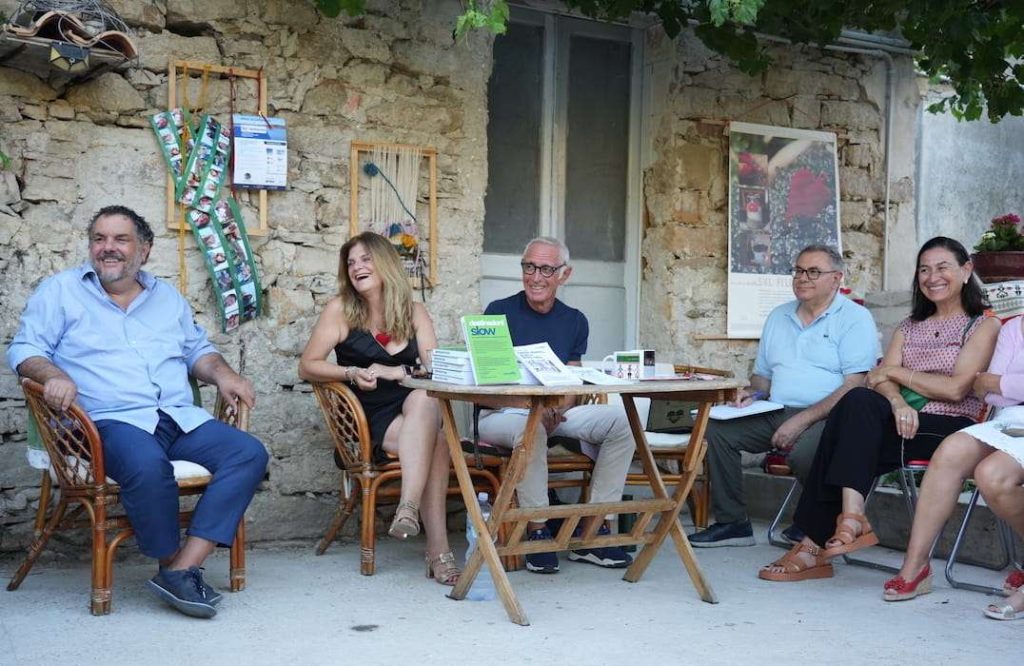
At the end of the field training, the CTT™ will find the work well underway and will be able to consolidate and grow “his” GMT™ (an acronym for Territorial Marketing Group) in quality.
The GMT™ Model is based on the activation of a collaborative network of local professionals and partners, who bring to bear skills and competencies, managed in an integrated way, to activate and coordinate an informal group of tour operators, agri-food producers, artisans, local businesses, chosen excellences to compose programs of tourism experiences that are an expression of the genius loci and identity culture of a local community.
It is a repetition of the geometric model of fractals, which is repeated in its form in the same way on different scales, according to the principle of self-similarity.
The Ecosystem of Territorial Tourism Coordinators™ is present in the Italian regions and in Patagonia (Argentina)
Currently, the role of Territorial Tourism Coordinator™ is present in several Italian regions and in Argentina (in the Patagonia region) and is supported by a team of professionals from the Territori e Italianità ecosystem, who are able to ensure the continuity of the work that has been carried out.

Campania

Sardinia

Campania

Veneto

Argentina

Sardegna

Sicily

The CTT™ is trained in the field to facilitate operational learning of tasks that they will then perform independently by applying the GMT™ operational model, through the active-passive coaching of a destination temporary manager (individual or, if necessary, in a team).
Through an intervention of temporary management, local communities can thus equip themselves with the professional skills necessary for the tourism development of their area, the lack of which is often the main critical issue for most small Italian municipalities.
The tasks of the CTTs™ are articulated and significant:
♦︎ scouting of local operators (accommodation facilities – artisans – producers – service providers) interested in becoming part of the local tourism supply chain
♦︎ creation of hospitality marketing action planswith the creation of a catalog of structured tourism products as an output
♦︎ research and development of direct and indirect business channels for the sale of structured tourism products
♦︎ collection and management of the training needs of the area, both the tourism operators involved and local administrators
♦︎ onsite management of customers during their stay
GMT™ Model of Destination Temporary Management
© 2015 Andrea Succi All rights reserved
[1] For the concept of the common good, reference is made here to the “governance of the commons,” the theory that earned Elinor Ostrom the Nobel Prize in Economics in 2009. After several years of study and research, Ostrom posed the fundamental problem of how a group of interdependent subjects, referred to in her text as principals, could self-organize and self-govern in order to achieve long-term collective benefits, overcoming the temptation of free-riding and, more generally, opportunistic behavior. By conducting field studies of how people in small local communities manage shared natural resources such as pastures, fishing waters and forests, Ostrom showed that when natural resources are used jointly by their users, rules are established over time for how they are to be cared for and exploited in economically and ecologically sustainable ways.
“The Culture of Hospitality does not coincide with tourism, but is the prerequisite for it”
Andrea Succi
Before thinking about the promotion of an area/destination, it is necessary to have created
the cultural conditions, services, proposals and shared a vision and management model to which to then give visibility.
Making a culture of hospitality means addressing fragmentation and facilitating inter-municipal/inter-territorial forms of cooperation; this is a cultural change that only comes through a participatory approach.
The selection of CTTs™ is done exclusively through the P.S.Q. methodology. – Structured and Qualified Word of Mouth. Experience already in the field, strong motivation and resilience to maintain relationships with local adminsitrators are needed.
This is the testimony of Riccardo Zingone
Territorial Tourism Coordinator™ of GMT™ Halaesa Nebrodi in Sicily
A FILO ROSSO event, organized by the Council of Emilian-Romagnols Abroad and moderated by Magalì Pizarro, Territorial Tourism Coordinator™ of GMT™ Patagonia in Argentina
